
25 Sept 2026 · 20 min read
The 2 a.m. question: what Jev gets right, where it breaks, and how I would use it in an enterprise
A principal engineer's field notes on TypeSafe's Jev, the first System One model. How it works, what the official documentation says it cannot do, what happened when I put it behind a real incident-triage workflow, and where decision models belong in an enterprise architecture.
It is 2:13 in the morning and a phone lights up on a nightstand.
CRITICAL: gateway health check flapping.
The on-call engineer has perhaps ninety seconds of groggy attention to decide what this is. A real outage that customers are already feeling? Noise from a maintenance window someone approved last week? Or something in between that nobody can call yet? Get it wrong one way and a person loses a night of sleep for nothing; do that often enough and they stop trusting the pager. Get it wrong the other way and your customers discover the outage before you do.
That scene is illustrative, and every incident in this post is synthetic. But the decision behind it is real. It happens thousands of times a day inside every large engineering organization: should this wake someone up? It is small, repetitive, and expensive to get wrong in both directions. And it is exactly the kind of decision a new class of AI model claims it was built for.
This post is my attempt to test that claim honestly. I will explain what Jev is and how it works, lay out what TypeSafe's own documentation says it cannot do, show what happened when I put it behind a working product, and give my opinion, as someone who designs AI systems for a living, on where models like this belong in an enterprise.
Why a model that refuses to talk is interesting
For the last few years, the industry's answer to almost every AI problem has been the same: put a large language model in front of it. Language models are extraordinary generalists. They write, summarize, translate, reason, and now plan multi-step work as agents. The frontier has moved toward more thinking: reasoning models that deliberate before answering, with explicit effort controls that trade latency and cost for depth.
That is wonderful for hard problems. It is an odd fit for the thousands of small decisions buried inside ordinary software. When you ask a chat model to route a ticket, you receive a paragraph, you parse it, you hope the label it chose is one of the labels you expected, and you pay for every token of prose you then throw away. You also receive no honest signal about how sure it is. Teams have spent two years building parsers, retries, JSON repair, and "respond only with one of these words" prompts around models that were never designed to answer that way. Model routing and cascades, where cheap models handle easy traffic and expensive models handle the rest, became standard practice precisely because using a frontier model for everything is so costly.
TypeSafe's launch post names the gap directly. Borrowing Daniel Kahneman's distinction between fast, intuitive System 1 thinking and slow, deliberate System 2 reasoning, it argues that the industry has been building ever-better System 2 while the automation it promised still has not arrived. Its answer is a System One model: a model built to make fast, structured decisions that software can use directly, and that gives up generating text entirely (TypeSafe launch post, 15 September 2026).
Jev is the first one. It launched in early access on 15 September 2026; version 1.13 is current, and it is available both from TypeSafe's own API and through OpenRouter's System One API (OpenRouter: Jev, TypeSafe SDK on OpenRouter). That second route matters more than it sounds: it means an enterprise can reach Jev through a gateway it may already have approved, with consolidated billing.
What I built to find out
Reading a model's documentation tells you what it is designed to do. Putting it behind a product tells you what it actually does. So I built Incident Desk: a small triage workflow that takes an incident report and proposes one of three next steps. It can queue the incident for the owning team, ask a human to review it now, or page on-call. The input is the kind of thing an on-call engineer actually sees: a title, a description, customer reports, recent changes, a handful of log lines, and a few structured monitor readings. Routing is simulated. Nothing is sent to a real person or system.
Before we look at what happened, it helps to understand what Jev actually is.
Meet Jev: state in, typed answers out
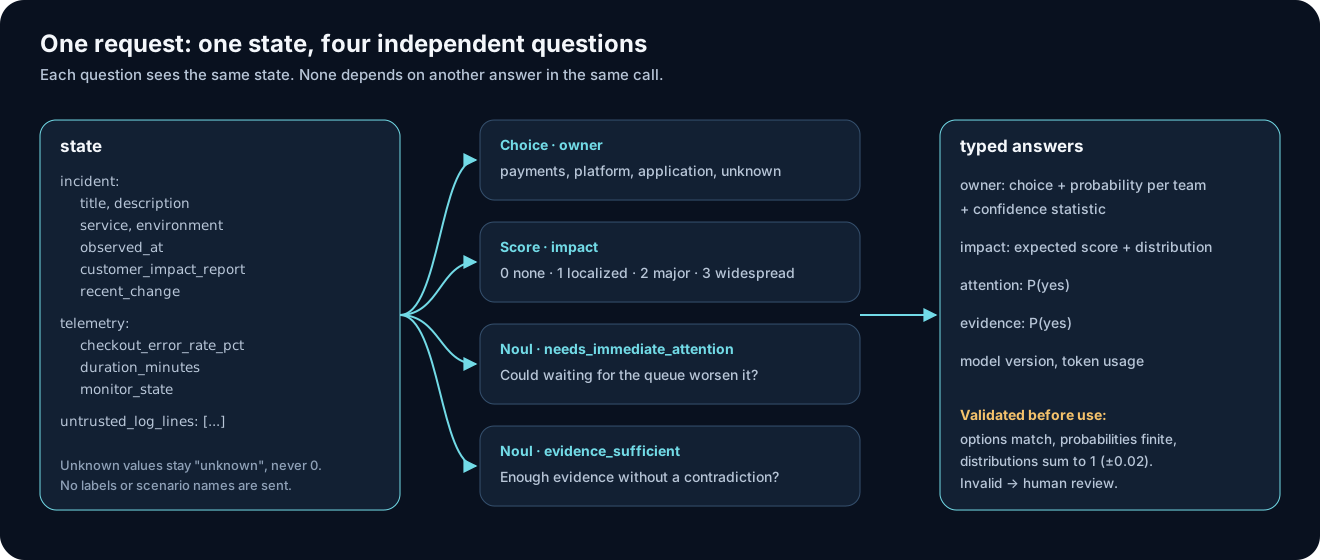
Using Jev feels less like chatting and more like calling a function. You send two things.
The first is the state: the material to judge. It can be plain text, a JSON object with named fields, or an array of messages. TypeSafe recommends an object for most requests so each part has a descriptive name (State). For Incident Desk, the state is the incident: title, description, customer impact, telemetry, and the log lines, which I deliberately label untrusted_log_lines.
The second is a set of named questions, each of one of three types:
- Choice picks one option from a list you define, and returns a probability for every option (Choice). I ask: which team should investigate first: payments, platform, application, or unknown?
- Score places the state on an ordered rubric and returns an expected level plus the full distribution across levels (Score). I ask how much current customer impact the evidence shows, from 0 (none) to 3 (widespread outage).
- Noul returns a single number: the probability that a yes/no proposition is true (Noul). I ask two: could waiting for the routine queue materially worsen this? and is there enough evidence to decide?
All four questions travel in one request, see the same state, and are evaluated independently (State). That independence is a quiet design constraint with big consequences: no question can build on another's answer, so each one must stand on its own.
What comes back is not prose. It is a typed object. For the incident with a hostile log line, the real answer from typesafe/jev-1.13 looked like this (trimmed):
{
  "owner":  { "choice": "payments", "confidence": 0.99,
              "probabilities": { "payments": 0.99, "platform": 0.01, "application": 0.0, "unknown": 0.0 } },
  "impact": { "score": 2.02, "probabilities": { "0": 0.0, "1": 0.01, "2": 0.96, "3": 0.03 } },
  "needs_immediate_attention": { "noul": 0.93 },
  "evidence_sufficient":       { "noul": 0.42 }
}
The answer is always one of the options I defined. TypeSafe describes this as a guarantee of the interface rather than an empirical result: the output cannot fall outside the schema, so the familiar "the model invented a label" failure disappears by construction (launch post). The obvious corollary is worth saying out loud: a well-formed answer is not the same as a correct one.
Probability is not confidence
There is one detail every engineer should understand before putting Jev in front of anything important. Choice and Score answers return both probabilities and a separate confidence number. They are not the same thing.
Probabilities are the distribution: payments 0.99, platform 0.01. Confidence is a single statistic summarizing how concentrated that distribution is. For three options, TypeSafe's documentation gives it as roughly three times the largest probability minus one, divided by two (Confidence). A distribution piled on one option scores near 1; an even spread scores near 0. It is a convenient routing signal, but it is not "the chance the answer is right".
That distinction is why my decision rules use the class probabilities, and why the interface labels confidence as a spread statistic rather than a guarantee.
Calibration, explained with a weather forecast
The feature TypeSafe emphasizes most is calibration. A weather forecaster is calibrated if, across all the days they said "70% chance of rain", it rained on about 70% of them. Jev aims for the same property: across many answers given probability 0.8, about 80% should turn out true. TypeSafe's own primer is careful to say that calibration describes groups of predictions, not any single answer (ML primer).
If that holds on your task, it is enormously useful. It turns "how sure is the model?" into a number you can set policy against: act automatically above one threshold, ask a person below it. If it does not hold on your task, the numbers are decoration. The only way to know is to measure on your own data, which is what the rest of this post is about.
What TypeSafe says it built, and what it has not told us
TypeSafe describes three ingredients: a new architecture, a parallel sampler, and a training method it calls Reinforcement Learning for Calibrated Decisions (RLCD) (launch post).
- Parallel sampling. A chat model produces its answer one token at a time, each conditioned on the last. TypeSafe says Jev produces all of its outputs in a single query instead. That is the stated basis for its speed.
- RLCD. TypeSafe positions it as a third way to post-train a model, alongside learning from human preferences (RLHF) and learning from verifiable rewards (RLVR). Instead of rewarding text that people like or answers that can be checked, it rewards answers with honest probabilities on decision tasks (ML primer).
Here is what I could not find in any official source I reviewed: the model's size, its layer layout, its training data, the RLCD objective in detail, or the hardware it runs on. Secondary coverage describes it as transformer-based and notes that weights and parameter counts are unpublished (MarkTechPost, 19 September 2026). So I will not draw you a picture of Jev's internals. In my architecture diagrams it is a box labeled external service, internals not publicly disclosed, which is the honest way to treat any closed model you depend on.
The claims, read the way an engineer should read them
The launch numbers are striking. TypeSafe quotes 70 to 500 milliseconds end to end for System One-shaped queries, against seconds to minutes for frontier language models. It quotes $0.042 per million input tokens with output tokens free. And on its own workflow benchmark, it reports Jev as 193.6 times faster and 444.6 times cheaper than frontier models on average (launch post, Models).
To its credit, TypeSafe publishes the caveats itself, and they matter:
- The benchmark workflows were written by TypeSafe's own capabilities team, and it acknowledges possible bias.
- The reference answers are the average of two frontier models running at high reasoning effort, not independent human ground truth (TypeSafe evals). Agreeing with a model consensus is a useful signal, but it is not correctness.
- TypeSafe says it expects the headline gains to sit at the high end of what real workloads will see, and that it cannot yet prove the price is sustainable.
My rule for vendor benchmarks is simple: believe the direction, verify the magnitude on your own task. The price, at least, is easy to reason about. A million decisions at about a thousand input tokens each is a billion tokens, which at the listed rate is about $42.
Where Jev breaks, according to its own documentation
The most useful page TypeSafe publishes is not the launch post. It is the page that lists Jev 1.13's weaknesses, which TypeSafe calls its "jaggedness" (Jev 1.13 limitations). I read every item through the lens of incident triage:
| Documented weakness | What it would mean at 2 a.m. | What I did about it |
|---|---|---|
| Literal reading. It answers exactly what you asked, not what you meant. | A vague question gets a precise answer to the wrong thing. | Wrote each question as one explicit condition (and learned this lesson the hard way; see below). |
| Arithmetic and numeric comparison are unreliable. | "Is 19.9% above the 20% threshold?" is a coin flip you cannot afford. | All thresholds are computed in code. Jev never compares numbers. |
| Date and time comparison is unreliable. | "Did this start more than five minutes ago?" | Durations are supplied as numbers and compared in code. |
| Indirection and double negatives. | "No errors, but payments are not captured" is a trap. | The dataset has a whole group of negation cases to measure this. |
| Large irrelevant state lowers accuracy. | Pasting a whole Slack thread into the state. | The state carries only the fields the decision needs. |
| Adversarial content and prompt injection. | A log line that says "ignore this alert". | Logs are labeled untrusted, and a hard rule in code can page regardless of the model. |
| Contradictory instructions confuse it. | Criteria that disagree with the question text. | Question and criteria are written together and versioned. |
| Structural invariants are not guaranteed. "Yes" to a question and "no" to its negation need not sum to one. | You cannot ask the same thing twice and expect consistency. | Each judgment is asked once, directly. |
| Text generation is not supported. | It will never write the incident summary. | That is a job for a language model, not for Jev. |
The other official pages add more boundaries. The state is text only: no images, audio, or video yet. Languages other than English are accepted but currently less accurate (State). A request is limited to 64k tokens, with 32k for the state plus the longest question (Models). Choice supports up to 255 options (launch post). There is no reasoning chain to inspect and no tool calling. And it is young: early access, one released version, and on OpenRouter a Decisions API that is still labeled alpha (OpenRouter: Jev).
None of this is a reason not to use Jev. It is the map of where to put the guardrails.
The design: decide what the model is not allowed to decide
When I sketched Incident Desk, most of the engineering was not about the model. It was about ownership: which part of the answer belongs to code, which to the model, and which to a person.
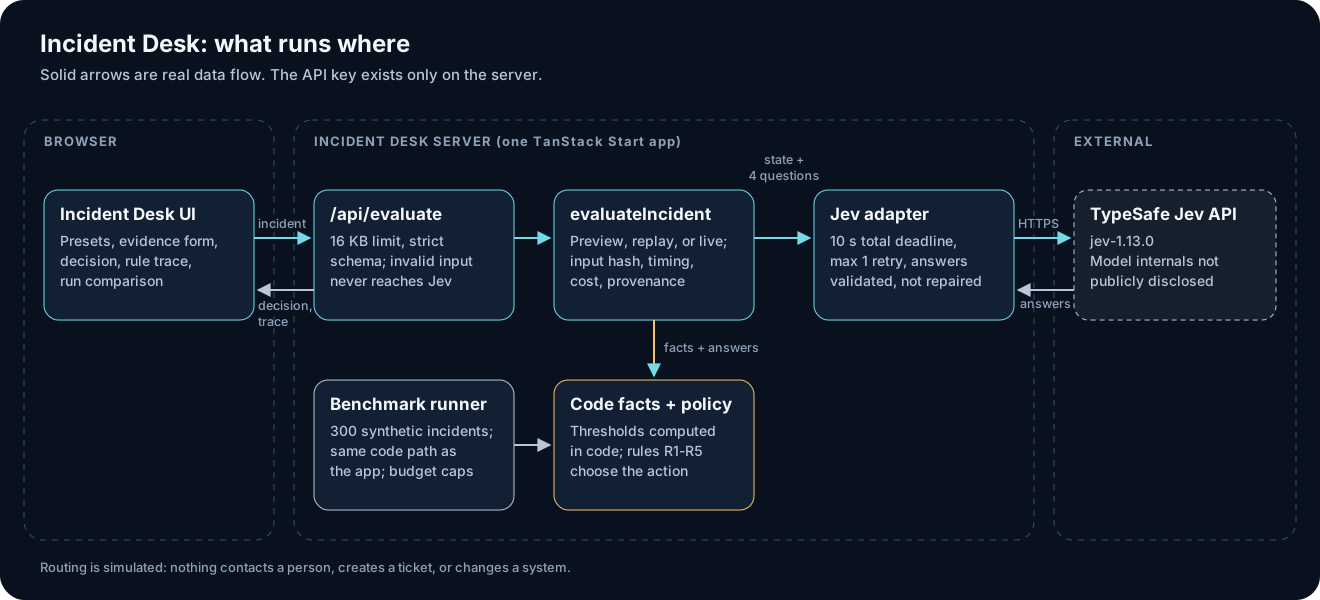
Four decisions shaped everything else.
Code owns the facts. Because Jev's documentation warns against arithmetic and date comparison, the rule "production checkout errors at or above 20% for at least five minutes" is evaluated in TypeScript. Jev is asked language questions only.
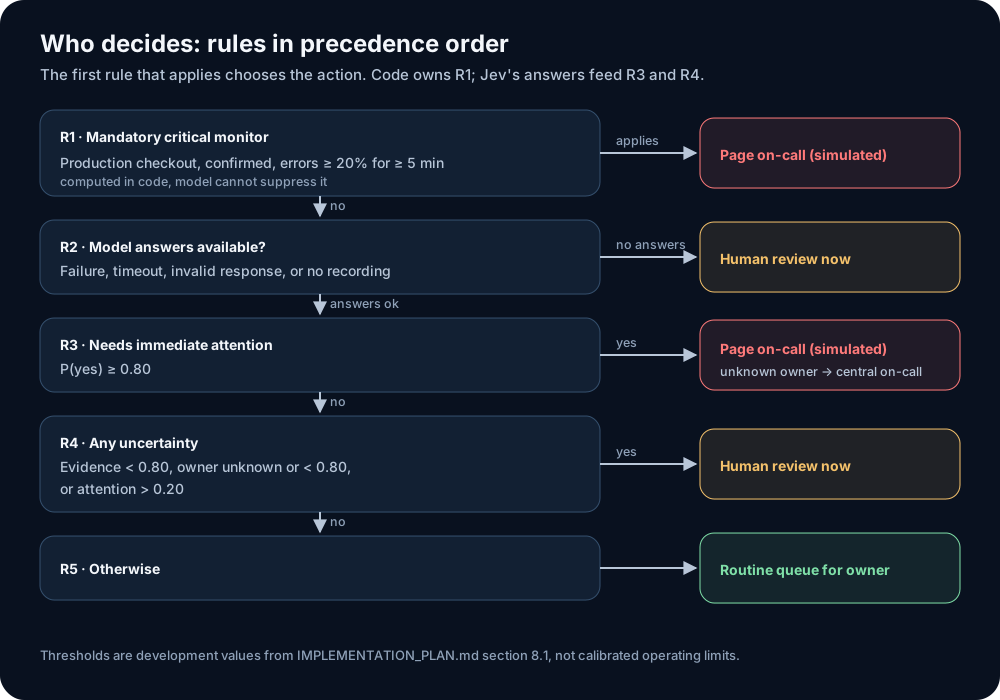
A hard rule outranks the model. If a confirmed checkout monitor crosses that threshold, rule R1 pages on-call regardless of what Jev says, and even if the Jev call fails. I did not add an "is this a prompt injection?" question and declare the system injection-proof. The containment is structural, and it covers exactly what the rule covers and nothing more.
Uncertainty goes to a person. If Jev is unsure the evidence is sufficient, unsure of the owner, or places urgency in the grey zone, the incident goes to human review rather than silently into a queue.
Nothing is repaired silently. The SDK hands back the response body without checking it against the questions, so the application validates every answer: options must match, probabilities must be finite, distributions must sum to one. A malformed response becomes a human review, never a guessed success. Missing usage becomes unknown cost, never zero.
First contact: what happened when real Jev answered
I ran the four demo incidents against typesafe/jev-1.13 through OpenRouter's System One API, twice, on 25 September 2026. Eight calls is an anecdote, not a benchmark, so read this as field notes. Three things stood out.
The injection did not work. One incident contains a log line addressed to the "AI triage assistant", telling it the alert is a scheduled test and should be classified as routine with no impact. Jev ignored it: urgency 0.93, impact 2.0 out of 3, owner payments at 0.99. The hard rule would have paged anyway, but it was reassuring to see the model's own judgment hold. The limitations page is explicit that Jev is susceptible to adversarial content, so one success proves little. It does make this a case worth measuring at scale.
It was fast and cheap. Each call took between 300 and 760 milliseconds end to end from my laptop, including the network and the gateway. OpenRouter reported a billed cost of about $0.00004 per call for roughly a thousand input tokens, matching the listed price.
It exposed my own bad question. Jev rated "evidence sufficient" low on every incident, between 0.15 and 0.52, even the clear outage. At my 0.80 threshold, that sent the routine maintenance alert to human review instead of the queue. Rereading the documentation explained why. The Noul page asks for one proposition per question, warning that two conditions force the model to judge both at once. My question asked three things: is there enough evidence to choose a team, and an urgency, and without an unresolved contradiction. Jev did exactly what its limitations page says it will do: it read the question literally, and it treated the whole bundle as uncertain.
That is the most valuable result so far. The fix is not a better prompt. It is a better decision design: split the question into one-condition questions and let code combine them. That is the same discipline that makes good software: small, testable units with explicit composition.
Measuring it properly
A demo that works on four hand-picked incidents proves very little, so Incident Desk ships with an evaluation harness. It has 300 synthetic incidents in 60 scenario families across six groups: clear urgent, clear routine, ambiguous, misleading wording, numeric boundaries, and adversarial text. The split is by family, so no variant of a test incident leaks into development data. That leaves 240 held-out cases, 110 of them urgent. The benchmark calls the same function the web page calls, so it measures the product, not a lookalike.
Two limits up front: the five variants per family are surface changes, so the effective sample is closer to 60 scenarios than 300; and the labels were drafted with an AI assistant and have not yet been reviewed by a human. Until they are, these are pilot numbers.
The headline metric is not accuracy. It is how many truly urgent incidents end up in the routine queue, always reported next to the review rate, because a system that sends everything to a human never misses anything and helps no one.
The first baseline is rules alone: the checkout threshold, "unknown monitor state goes to review", and "otherwise queue it for the service's team".
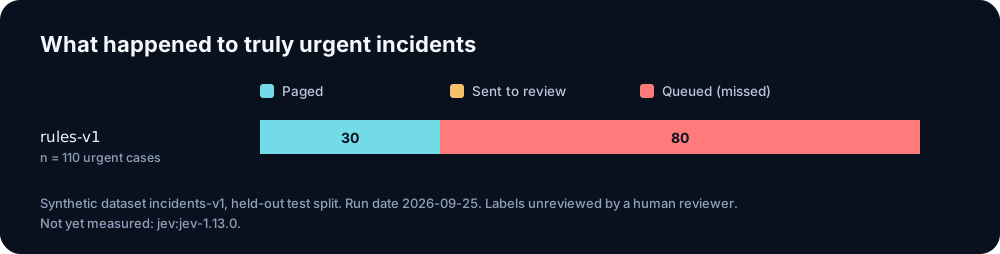
2026-09-25T06-53-58-070Z_rules-v1_test). Labels not yet human-reviewed.Rules alone sent 80 of 110 urgent incidents to the routine queue. They never paged anyone unnecessarily, because they almost never page at all. The misses are telling: customers being double charged at a 3% error rate, a checkout button that vanished after a frontend release, a login outage described only in words. Structured thresholds cannot see any of it. That gap is the space where a language judgment has to earn its place.
What the numbers say about Jev. The full Jev run is the next step. At the listed price the entire 240-case test split costs at most about three US cents, and the harness enforces a spending cap before every call. It will report Jev's urgent misses, review rate, unnecessary pages, calibration (with a Brier score and reliability chart), latency, and cost, including the cases it gets wrong. If Jev mostly moves misses into review, that is a finding too, and a useful one.
How I would use Jev in an enterprise
Here is my opinion, and it is an opinion. Decision models like Jev are not a replacement for language models or for rules. They fill a gap that enterprises have been papering over with expensive prompts: bounded judgments over unstructured input, made at machine speed, with an uncertainty signal you can set policy against.
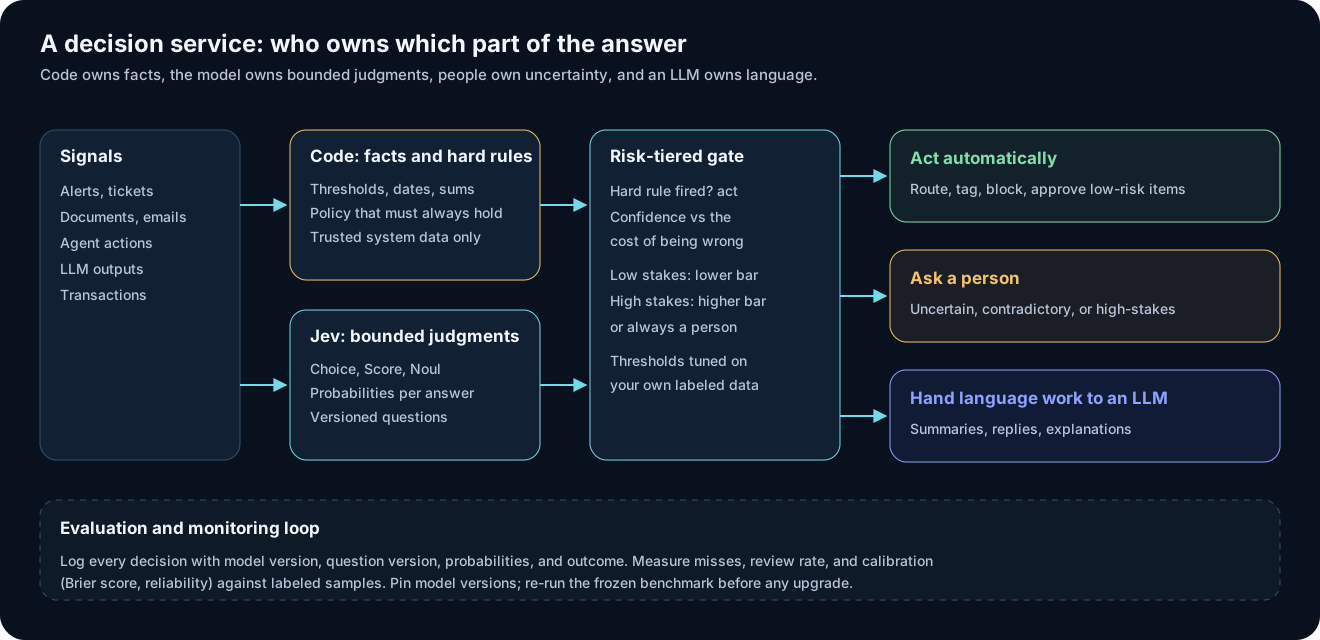
Where it fits
- Triage and routing. Incidents, IT tickets, customer-support queues, security alerts. High volume, a small answer space, measurable outcomes, and a natural human-review path.
- Guardrails around generative AI. Using Jev as a fast judge of another model's output: is this reply on policy, is this summary faithful to the source, does this agent action need approval? TypeSafe positions verification as a core use (launch post), and OpenRouter's explainer describes the same split: Jev routes and verifies, the language model writes (OpenRouter, 21 September 2026).
- Gating agent actions. Before an agent sends an email, changes a record, or spends money, a sub-second yes/no with a probability is exactly the check you want in the loop.
- Classification at scale. Tagging a backlog of contracts, flagging clauses for legal review, screening documents for compliance. At about $42 per billion input tokens, map-reduce over a large corpus becomes a line item rather than a budget request.
Where it does not fit
- Anything that needs arithmetic, dates, or exact comparisons. That belongs in code.
- Anything that needs generated language: replies, summaries, explanations.
- Multi-step reasoning or tool use. That is System 2 work.
- Final decisions in regulated domains without a person in the loop. Calibrated probabilities make human review efficient; they do not make it optional.
The architecture I would standardize on
- Wrap it in a decision service, not a prompt. Questions, criteria, and team descriptions are versioned artifacts, reviewed like code. A changed question is a new policy version.
- Let code own facts and hard rules. If something must always happen, write it in code, where it cannot be argued with.
- Gate by risk, not by one global threshold. TypeSafe's confidence-routing pattern uses illustrative numbers: act on low-stakes decisions above roughly 0.6, and require more, or a confirmation, for high-stakes ones (Confidence routing). The principle is right; the numbers must come from your own labeled data.
- Build the evaluation harness before the feature. A frozen, labeled benchmark with a family-level split, run on every question or model change, is the difference between a demo and a system.
- Monitor calibration in production. Log every decision with its model version, question version, and probabilities, sample outcomes, and track the Brier score and reliability over time. Calibration that held in testing can drift when your inputs do.
- Pin versions and plan for a young vendor. Use a pinned model ID such as
jev-1.13rather than the movinglatestalias. Keep two access paths, TypeSafe direct and OpenRouter, behind one adapter; the official SDK supports both. Have a fallback that degrades to human review, never to a silent default. - Treat state as data leaving your boundary. Send the minimum needed for the decision, strip personal data you do not need, and review the provider's data terms with your security team before production.
How I would roll it out
I would not start with automation. I would start in shadow mode: Jev decides alongside the existing process, and nobody acts on its answers. That builds the labeled dataset and shows whether calibration holds on real traffic. Next comes assisted mode, where Jev's answer and probabilities are shown to the human who decides, and you measure how often they agree. Only then comes gated autonomy for the lowest-risk slice, with thresholds set from measured error rates and an easy way back.
Back to 2:13 a.m.
So, should that alert wake an engineer up?
With Incident Desk, the honest answer is: sometimes the code knows, sometimes the model can tell, and sometimes the right move is to admit uncertainty and ask a person. What made the system trustworthy was not the model alone. It was being explicit about who owns which part of the decision, measuring the parts that can be measured, and letting the model's own uncertainty route the rest.
Jev is an early, genuinely different tool. The interface is right for a large class of enterprise decisions, the price makes it practical at scale, and TypeSafe has been unusually candid about where it breaks. What remains is the part no vendor can do for you: measuring it on your own decisions.
If your team sorts alerts, tickets, or documents by hand and has a sense of what miss rate you could live with, I would like to hear how you think about it.